About Me
I am an observational astronomer currently working as a Postdoctoral Researcher at INAF – Osservatorio Astronomico di Roma, where I collaborate with Laura Pentericci and the extragalactic group at OAR.
My research focuses on the formation and evolution of galaxies in the early Universe, with a particular emphasis on the ionizing properties of high-redshift galaxies. I primarily use observations from the James Webb Space Telescope to investigate how the first galaxies shaped the epoch of cosmic reionization.
I was born and raised in Quito, Ecuador, where I studied Physics before moving to Chile to pursue a PhD in Astronomy at Universidad de La Serena under the supervision of Ricardo Amorín.
I am currently an active member of the CEERS, CAPERS, and OCEANS collaborations. I also participate in the MOONRISE collaboration, contributing to the development of source catalogs for the upcoming MOONS instrument at VLT.
Education: PhD in Astronomy: Universidad de La Serena, Chile. Thesis
Research Interests: low-mass galaxies, starbursts, high-z galaxies, cosmic reionization
Publications: ADS link!
Web of Science: Profile here!
Research
Low-mass Starbursts at High Redshift
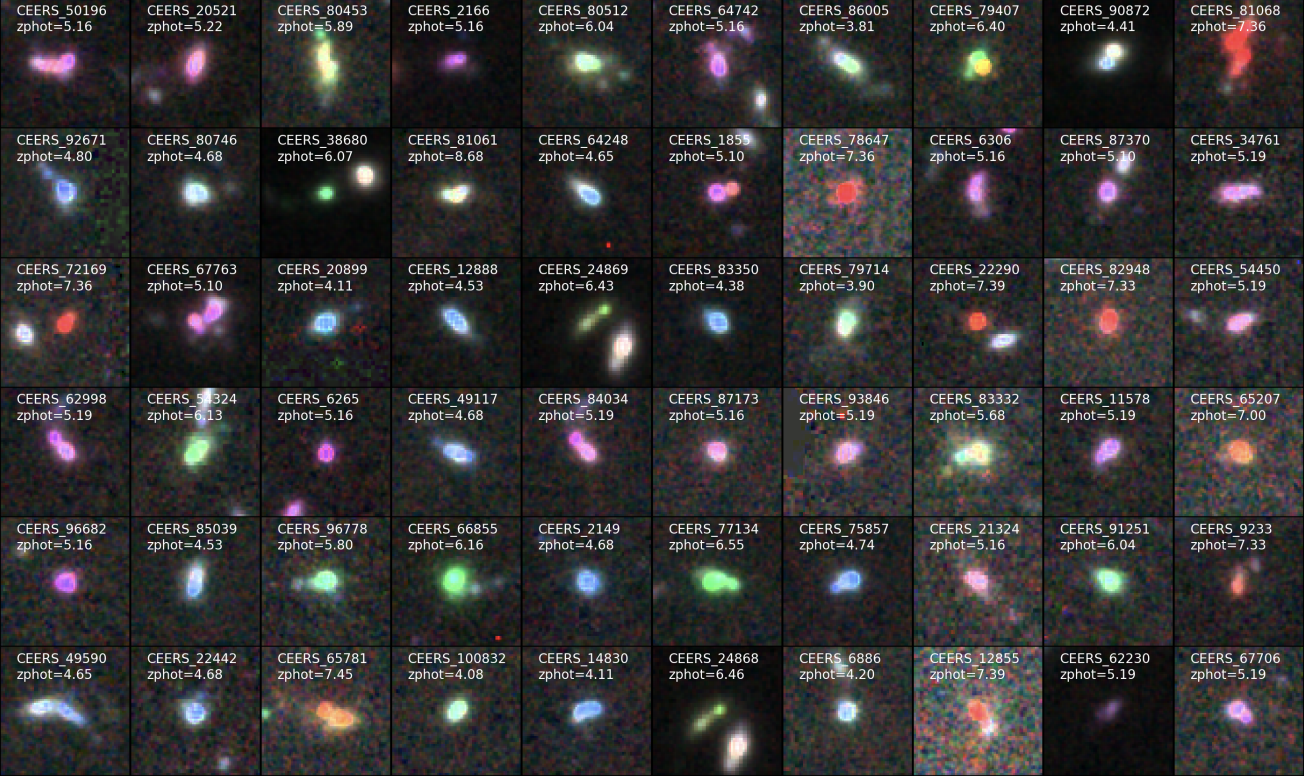
My research goal is to identify galaxies undergoing extreme star-formation activity in the early Universe using JWST photometric and spectroscopic observations. By combining robust photometric selection techniques with empirical templates of local metal-poor starbursts, I identify promising high-redshift analogs of young, intensely star-forming systems. Through detailed SED-fitting analyses, I derive their physical properties and investigate the connection between extreme star formation and strong nebular emission. Paper 2024|Paper 2026
Ionizing Photon Production and Escape in High-Redshift Galaxies
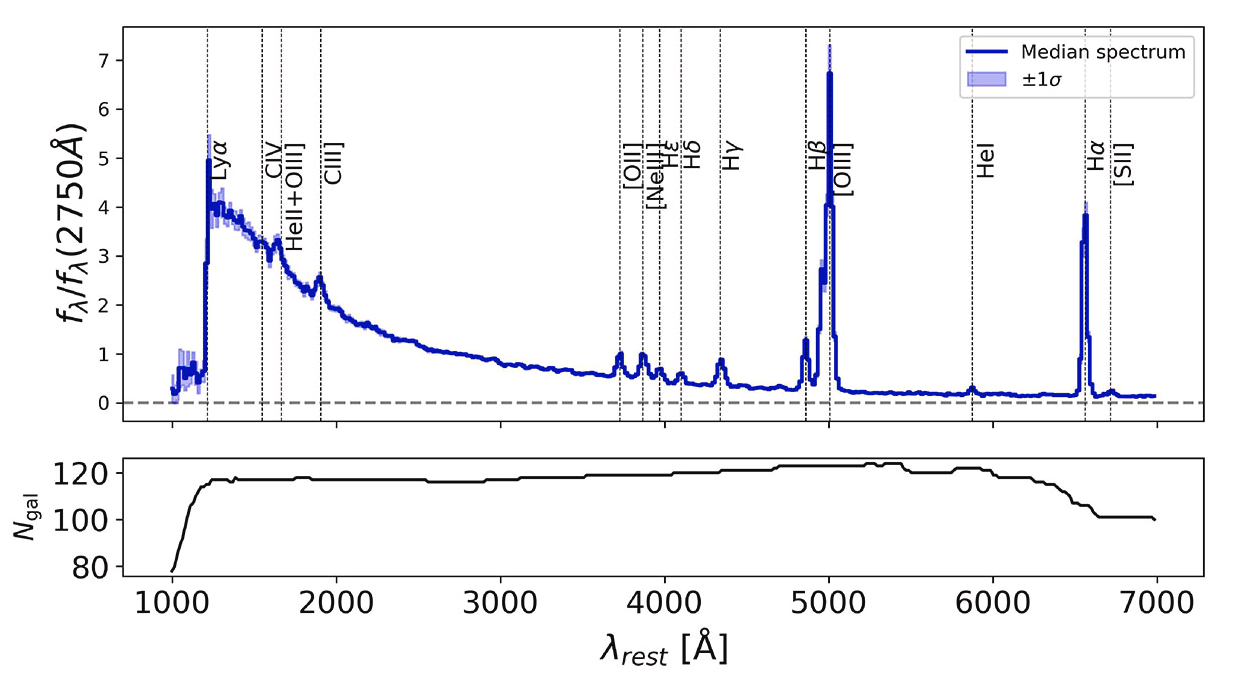
My research goal is to understand the production and escape of ionizing photons in galaxies during the epoch of cosmic reionization. Using large spectroscopic samples from JWST surveys, I investigate how the ionizing photon production efficiency and Lyman continuum escape fraction depend on key galaxy properties such as stellar mass, star-formation activity, and nebular emission. In particular, I focus on extreme emission-line galaxies as potential major contributors to the ionizing photon budget of the early Universe. Paper 2025
Analogs of Early Galaxies at Cosmic Noon
My research goal is to study the rest-frame UV and optical properties of z∼2−4 analogs of high-redshift galaxies, with the aim of understanding their physical conditions, chemical enrichment, and feedback-driven evolution. A key aspect of my work is the role of stellar feedback in shaping galaxy evolution at cosmic noon, where I study how outflows and bursty star formation regulate gas removal, metallicity evolution, and nebular emission in compact galaxies. Paper 2022|Paper 2023
Future ground-based spectroscopy
More recently, I have been involved in the validation and optimization of photometric redshifts for future spectroscopic surveys as part of the MOONRISE Collaboration. My work focuses on testing the accuracy of photo-z estimates derived from ground-based imaging by cross-matching MOONRISE catalogs with JWST/NIRCam photometry and available NIRSpec spectroscopy. This effort directly supports the optimization of high-redshift target selection for the upcoming VLT/MOONS spectrograph, with a particular focus on bright z>4 galaxy candidates.
Research Grants
Funded Research Projects
2025 — Curiosity Science INAF Grant
Stellar outflows driving ionizing photon escape
in the early Universe
PI: M. Llerena, Italy.
Budget: 15000 EUR
This project addresses two fundamental open questions in galaxy formation and cosmic reionization: i)
the contribution of faint UV galaxies (MUV ≳ −18) to the ionizing photon budget during the Epoch of
Reionization (EoR), and ii) the role of stellar-driven feedback in facilitating Lyman Continuum (LyC)
escape. Although faint galaxies are expected to dominate the ionizing emissivity at z>5, their physical
properties and internal physical mechanisms remain poorly constrained, and whether they are
intrinsically more efficient ionizing sources than their UV-bright counterparts is actively debated.
2024 — INAF Mini-grant
Galaxies in the epoch of Reionization and their
analogs at lower redshift
PI: M. Llerena, Italy.
Budget: 16000 EUR
Understanding the physical properties of galaxies in the epoch of
Reionization (EoR) is key to unveil the early phases of galaxy
evolution. The James Webb Space Telescope (JWST) has opened
the possibility to study such galaxies directly to constrain their
properties and to probe the evolution across the cosmic time and
back to the EoR. Besides that, analogs at lower redshifts remain
important to ensure a complete picture of the processes occurring
in those systems. In this project our science goals are: 1) study the
evolution of the production efficiency of ionizing photons at z~4-
10. 2) study the properties of extreme emission line galaxies that
show Lyman-alpha (Lya) emission at z~3.
Talks/Posters
Here is a compilation of science talks/posters I’ve given. If you’re interested in hearing more about these topics, feel free to reach out to me.
Physical properties of extreme emission-line galaxies at z=4-9 from the JWST CEERS survey - Conference: Cosmic Dawn at High Latitudes (Sweden) Slides
Ionized gas kinematics in UV emission-line galaxies at z=3 - Conference: From galaxies to cosmology with deep spectroscopic surveys (France) Slides
Global properties of CIII]1908 emitting star-forming galaxies at z=3 in the VANDELS survey - IAA-CSIC Severo Ochoa Advanced School on Galaxy Evolution (Spain) Poster
Nebular properties of star-forming CIII]1908 emitters at z=3 - Conference: XIII Estallidos Workshop (Spain, Virtual) Slides
Contact
Email: mario.llerenaona@inaf.it
Address: Rome, Italy